-
Oak Brook
📍📞 630-705-99992625 Butterfield Rd. Suite 102E
Oak Brook, IL 60523📠 Fax: 630-705-1422✉️ inquiry@vervecollege.edu 🗺️ Open in Google Maps 🍎 Open in Apple Maps🕒Office HoursMon–Fri: 9:30 AM – 6:00 PM
Sat: 8:00 AM – 12:00 PM
Sun: Closed -
Chicago
📍📞 312-920-8822216 W. Jackson Blvd. Suite 900
Chicago, IL 60606📠 Fax: 630-705-1422✉️ inquiry@vervecollege.edu 🗺️ Open in Google Maps 🍎 Open in Apple Maps🕒Office HoursMon–Fri: 9:30 AM – 6:00 PM
Sat: 8:00 AM – 12:00 PM
Sun: Closed - Email:inquiry@vervecollege.edu
- Make a Payment
 Sign up
 Login
Login
- Home
- Programs
- Admission
- Resources
- ATI Entrance Exam Resources
- New E-Digital Library
- Refer a Friend
- School Newsletter
- Events
- Employers
- Job-Network
- Alpha Beta Kappa Candidates
- Verve College Library
- Graduation and Pinning Ceremony Photo Galleries
- Textbook Information
- Career Services
- Tutoring
- School Catalog
- FAQ
- Constitution Day Program
- Alumni
- Verve College Plans
- Financial Aid
- HEERF Reporting
- Satisfactory Academic Progress
- Apply For Financial Aid
- Net Price Calculator
- Return of Title IV Funds (R2T4)
- Financial Aid Office Code of Conduct
- Contact
- FAQs
- Verification Policy
- Vaccination Policy
- Student Right-to-Know Act
- Misrepresentation
- Information Security Program
- Academic Award Year
- Availability of Employee
- Cost of Attendance
- Health & Safety Exemption Requirement
- Students Rights and Responsibilities
- Leave of Absence
- Pell Formula
- Military Students
- Grants/ Scholarship Policy
- Contact Us
- Testimonials
- Blog
Is a Nursing Career Right For You?
Take The Free QuizHow Learning Anatomy Concepts Builds Stronger Clinical Assessment Skills
How Learning Anatomy Concepts Builds Stronger Clinical Assessment Skills
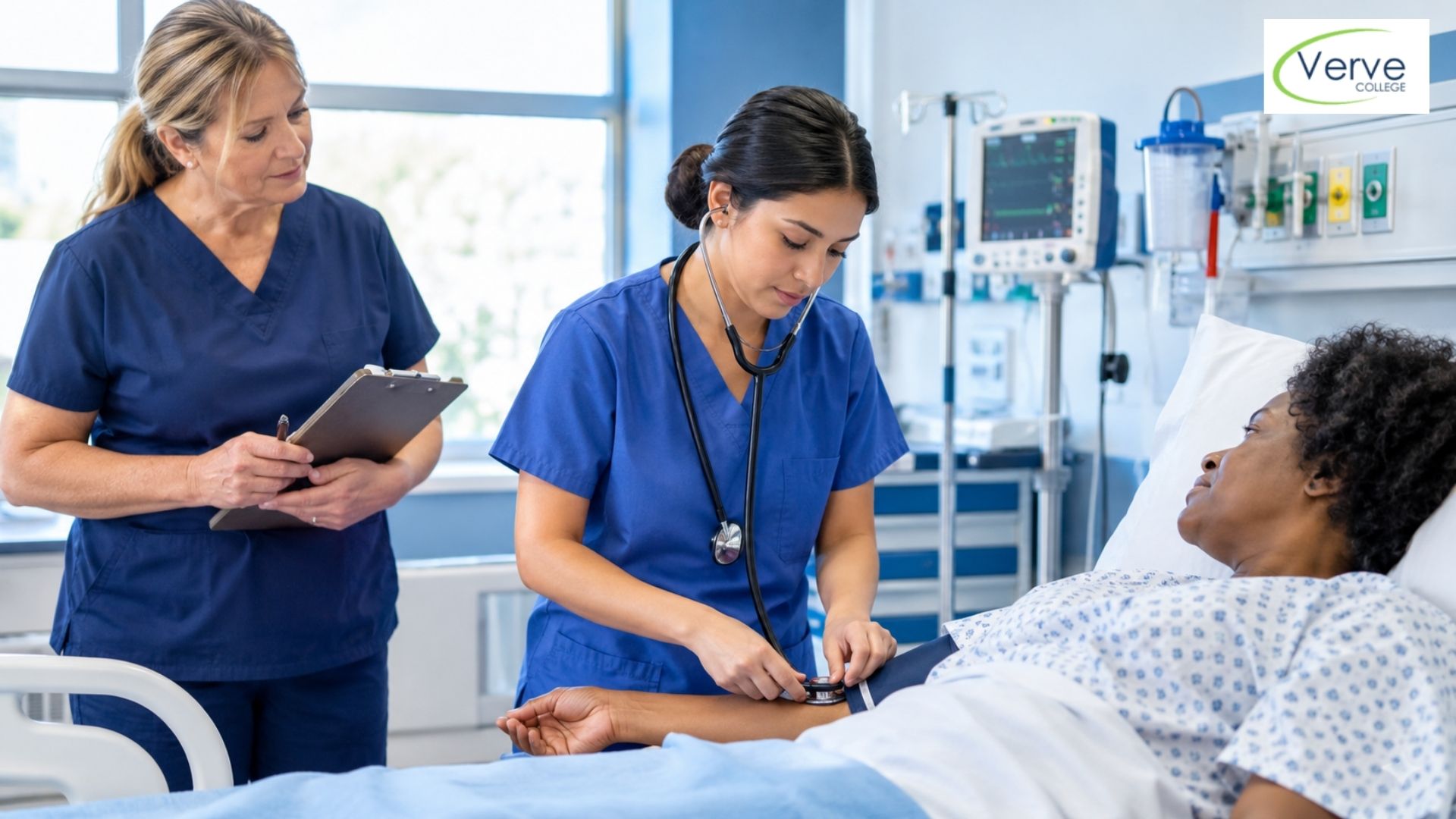
Walking into a patient’s room for the first time can feel intimidating for new nursing students. You are expected to check vital signs, listen to heart sounds, and notice tiny changes in a patient’s condition. Developing sharp clinical assessment skills starts long before you ever step onto a hospital floor. By enrolling in comprehensive anatomy and physiology classes, you build the foundational knowledge required to understand what is happening beneath a patient’s skin.
Key Takeaways
- Connecting Theory to Practice: Learn how surface anatomy helps you locate internal organs during physical exams.
- Identifying Abnormalities: Upper-level biology helps you understand baseline health metrics so you can immediately spot when a patient’s vitals are out of range.
- Improving Patient Safety: Discover why precise anatomical knowledge reduces clinical errors and boosts communication with doctors.
- Streamlining Your Education: See how prep classes prepare adult learners for the rigorous demands of nursing school.
What Are Clinical Assessment Skills?
Clinical assessment skills involve the methods healthcare providers use to evaluate a patient’s overall health status. This includes taking a detailed medical history, conducting physical exams, and measuring vital signs like blood pressure and heart rate. Nurses look at the whole picture to determine if a patient needs immediate medical attention.
To do this effectively, you must understand how a healthy body functions on a structural level. If you are currently searching for an anatomy and physiology course near me, you are looking for the exact toolkit needed to interpret these vital patient signs.
Why Anatomy Knowledge Matters for Patient Care
A nurse cannot identify an abnormal physical finding without first knowing what healthy tissue feels and looks like. For example, knowing the exact placement of the heart valves tells you where to put your stethoscope to listen for a murmur.
Using physical markers on the body, known as surface anatomy, allows you to find target areas without guessing. Palpating a pulse, listening to lung fields, or checking an abdomen all require a deep understanding of organ relationships.
When you understand these structural layouts, your confidence increases dramatically during stressful clinical rotations. You move from simply following a checklist to truly analyzing the unique condition of each patient.
How Anatomy Supports Daily Nursing Interventions
Every routine task you perform as a practical nurse relies heavily on your understanding of the muscular and nervous systems. Giving an injection requires identifying specific bony landmarks to avoid hitting a nerve or blood vessel.
Similarly, checking a patient’s neurological status requires knowing how cranial nerves control eye movements and facial expressions. When you observe a patient’s face drooping, your anatomical training tells you exactly which brain pathways might be compromised.
By mastering these body systems early, you protect your patients from preventable injuries and provide accurate data to the healthcare team. This specific science background helps you make sound clinical decisions during fast-paced hospital shifts.
Preparing for Your Practical Nursing Career
If you are ready to transition into healthcare, building a solid science background is the best way to ensure your future academic success. Finding high-quality anatomy classes near me can provide the tutoring, resources, and structured environment needed to excel.
Verve College offers an Anatomy and Physiology Prep Program specifically tailored for working adults and career changers. This course gives you a clear runway into our comprehensive Practical Nursing Program, helping you clear prerequisite hurdles without unnecessary stress.
Misconceptions About Learning Human Biology
Many introductory students assume that anatomy is purely about memorizing a long list of body parts and definitions. In reality, successful nursing education requires understanding how those parts interact to maintain balance, known as homeostasis. If you want to understand how this connects to hands-on training, learning about foundational body systems can give you a clearer picture of your future responsibilities.
Conclusion
Mastering the structure and function of the human body is the first major step toward clinical excellence. These basic concepts will guide every physical examination and patient interaction throughout your medical career. Investing in your prerequisite education now will give you a massive advantage when you begin your practical nursing coursework. Connect with an admissions advisor at Verve College today to find the perfect class schedule for your goals.
Get Your Nursing Career Training Readiness Score Now!
Frequently Asked Questions (FAQs)
How does anatomy help a nurse check a patient’s vital signs?
Anatomy teaches you where major arteries are located close to the skin so you can accurately measure a pulse. It also helps you understand the mechanics of breathing and blood flow, allowing you to interpret what high or low readings actually mean.
What happens if I struggle with science prerequisites or have been out of school for a long time?
It is completely normal to feel nervous about returning to the classroom after a long break. Enrolling in a targeted prep course with small class sizes and direct instructor access can help you rebuild your study habits.
How do I get started with anatomy classes at Verve College?
You can get started by visiting our website and reaching out to an admissions advisor to discuss upcoming class schedules. Our team will guide you through the enrollment process and help you plan your pathway into nursing.
Most Popular Blogs Posts

LPN School for Working Adults: What…
October 15, 2026 Read More
How to Prepare for Nursing School…
October 14, 2026 Read More
How Practical Nursing Students Build Clinical…
October 14, 2026 Read More
What Is Capillary Refill? A Guide…
October 13, 2026 Read More